Challenge
Live audio-reactive performance is unforgiving. The system has to respond to the song in real time, the projection has to land on a real venue that was not built for it, and there is no second take. If a cue drops mid-set, the audience sees it before the front-of-house tech does. The studio took on this work across a span of artists and venues that did not share a control system, did not share a rig, and did not share a rehearsal window longer than the soundcheck.
Approach
A live audio-reactive system tuned per show, built around a core stack the studio kept across engagements:
- Audio input. Direct feed from front-of-house, conditioned for transient response and low-frequency separation. Visuals react to the actual mix the audience hears, not a guessed mic in the room.
- Reactive content. Pre-authored visual scenes layered with parameters bound to audio bands. The visuals are not random; they are composed. The audio shapes how they breathe.
- Projection rig. Site survey first, projector placement modelled against venue geometry, redundant feeds where the rig allowed. Architectural mapping where the venue invited it (TIFF RBC House, OVO Summit at MTCC, OSHEAGA stage scale).
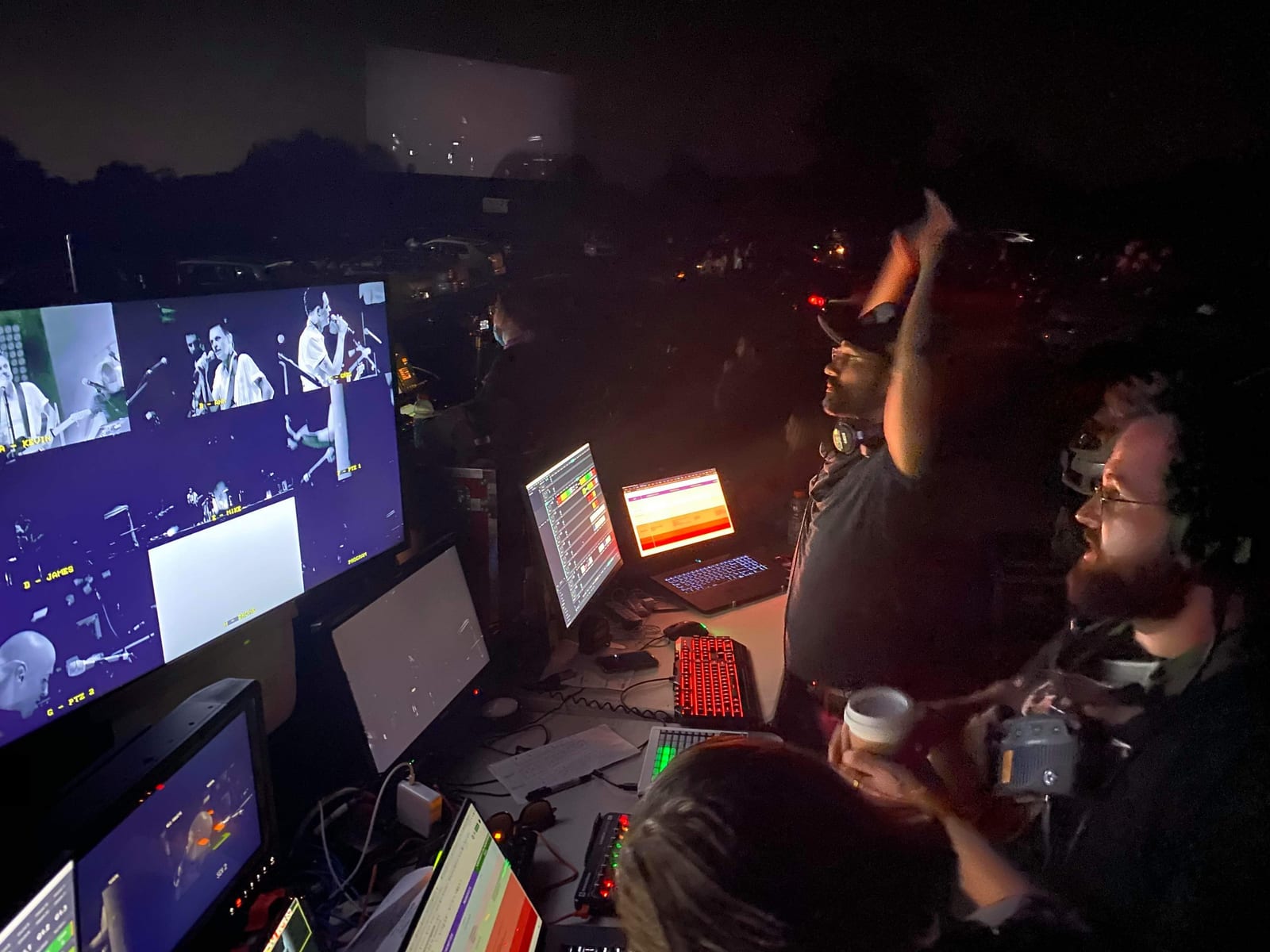
- Show-night operation. Studio operator in the booth on every show. No handing the rig to a stranger who did not build it.
This is the kind of work the brand now calls Spectacle tier. Adjacent to the Triple Helix lattice, not inside it: measurement is descriptive, the deliverable is the night itself, and the client buys the moment.
Selected dates
- July Talk Tour · projection mapping + live video production · cross-country, May-June 2019
- METRIC at OSHEAGA · live video production, audio-reactive effects · August 2019
- Majid Jordan featuring Drake · live video production, audio-reactive effects · REBEL, Toronto · April 2018
- NBA All-Star Saturday with Nelly Furtado · lighting design + live visuals · Storys, Toronto · February 2016
- OVO Summit · live video projection mapping + interactive intermissions · MTCC John Bassett Theatre · August 2019
Additional festival and venue work across Art Gallery of Ontario, Art Basel Miami, Scotiabank Arena, Design Exchange, Gardiner Museum, NXNE, Arts and Crafts Festival, Steamwhistle Brewery, Nuit Blanche x Hub14.
Instrumentation
| KPI | Method | Notes |
|---|---|---|
| Show completion | Run-of-show pass / fail | Every set hit cue without a recovery moment visible to the room |
| Repeat booking | Artist or production-team return | Multiple artists and festivals re-engaged across years |
| Footage capture | Fixed-camera + roaming capture | Deliverable handed back to the artist team post-show |
Result
| The Number | Tour-scale across artists and venues |
| Tier | ANECDOTE |
| Source | Public event records, artist production teams |
Spectacle work is measurement-light by nature. The proof is the booking the next year, the artist team naming the studio when their friend asks who did the visuals, and the festival putting the rig on the bigger stage the next season.
Impact
The system shipped a working live-reactive practice that fed forward into the Spectacle tier’s current reference set, including the 350×200 ft Dissolving Boundaries installation at Nuit Blanche 2025. The instinct for show-night discipline (redundant feeds, operator in the booth, soundcheck-only rehearsal windows) came from these years.
What we’d do differently
We did not capture the rig configuration as a reusable artifact for years. Each show was rebuilt from memory and a notes folder. A modern engagement now ships a documented run-of-show, a parameter snapshot of the reactive scene config, and an archive of the audio feed conditioning chain so the next show inherits, not relearns.
Footage capture was also under-scoped on the earliest shows. The artist remembers the room; the team remembers the cue sheet; nobody remembers the moment unless someone was paid to film it. Modern Spectacle engagements include the post-event footage package as a default deliverable, not an optional add.